![Picture of Mahibur Fakir [Hillol]](https://secure.gravatar.com/avatar/5d35a11815be0a5f73b6180975d1521fdd7694c880473d8ad5c74749dce26bd6?s=96&d=mm&r=g)
DHAKA March 10, 2026
It is the kind of number that stops you cold.
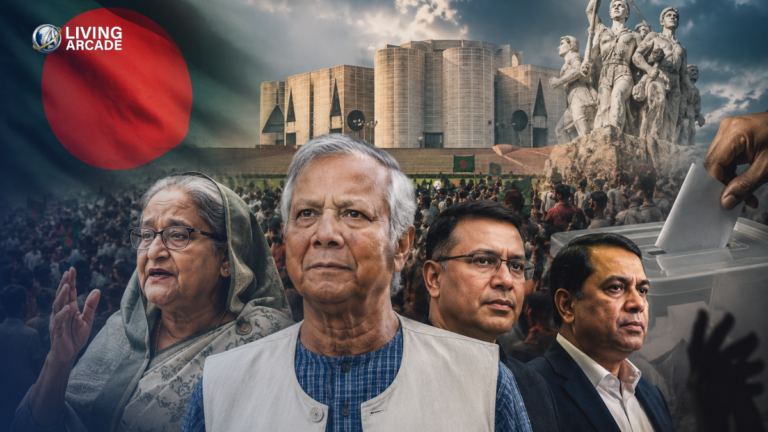
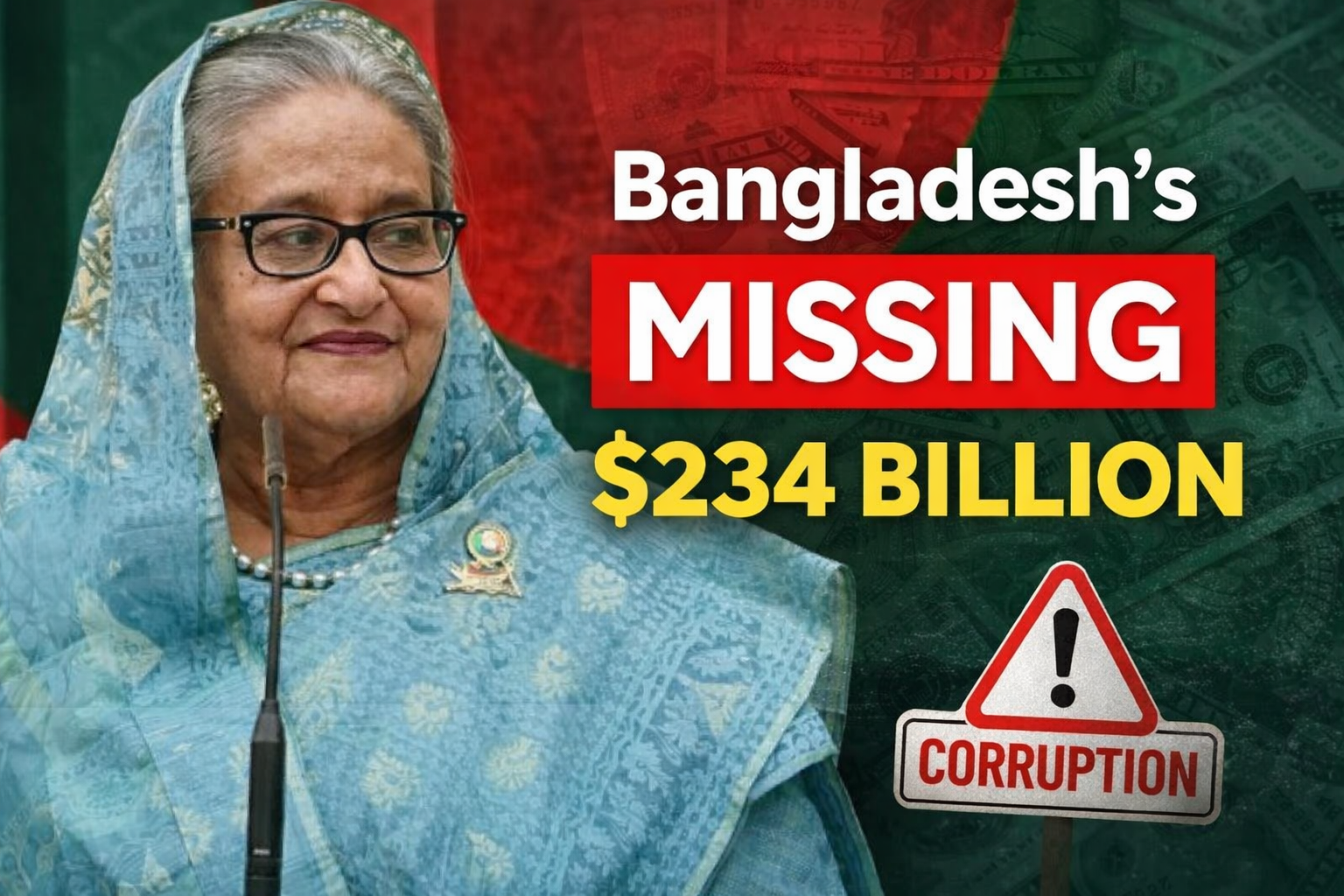
$234 billion. That is not the GDP of a small country. That is not a rounding error in a government budget. That is according to a formal economic white paper commissioned after the fall of Sheikh Hasina’s government the estimated total amount of money systematically looted and laundered out of Bangladesh over 15 years of Awami League rule.
To put it in perspective: Bangladesh’s entire annual GDP is roughly $460 billion. In other words, the country’s ruling elite allegedly stole the equivalent of half the nation’s economy and moved it quietly to London, Dubai, Singapore, Switzerland, Hong Kong, and New York while 170 million ordinary Bangladeshis went without adequate hospitals, schools, roads, and clean water.
This is the story of how they did it. And whether anyone will ever pay for it.
The Banks Were the Vault And the Keys Were Handed to Thieves
The mechanism of Bangladesh’s grand theft was not complex. It was brazen.
Over the past 15 years, one of the main areas of irregularities and looting has been the power and energy sector, while money was also looted from state-owned banks in the name of loans. PBS The pattern repeated itself with numbing regularity: politically connected businessmen would approach state-owned banks, obtain loans they never intended to repay, funnel the money offshore, and leave the bank holding a worthless shell company as collateral.
The Bismillah Group scandal at Janata Bank sparked a nationwide uproar in 2011. A year later, the Hallmark scandal at Sonali Bank came to lightPBS yet neither scandal produced meaningful accountability. The message sent to the powerful was simple: steal freely. The system will protect you.
After Dr. Ahsan H Mansur took charge as the Governor of Bangladesh Bank following Hasina’s fall, the boards of more than a dozen private banks were dissolved, and international audit firms were appointed to investigate the irregularities, corruption, and looting. Forensic audits and asset quality reviews have been completed for at least six banks.PBS What they found was catastrophic a banking sector hollowed out by years of politically directed lending to cronies and relatives of the ruling establishment.
The Nuclear Billions: A Deal Sealed in Secrecy
Of all the alleged corruption schemes of the Hasina era, the Rooppur Nuclear Power Plant scandal may be the most audacious.
Former Prime Minister Sheikh Hasina, her son Sajeeb Wazed, and niece Tulip Siddiq have been accused of embezzling more than $5 billion from the Rooppur Nuclear Power Plant project a scheme that costs Bangladeshi taxpayers $12.65 billion in total.NPR The project, Bangladesh’s first-ever nuclear power plant being built in partnership with Russia’s Rosatom, was supposed to be the crown jewel of Hasina’s infrastructure legacy. Instead, investigators allege it became one of the most lucrative corruption vehicles in the country’s history.
Bangladesh’s Anti-Corruption Commission has stated it intends to investigate Tulip Siddiq’s role in a 2013 nuclear power deal between Bangladesh and Russia.Tech Startups Siddiq who until recently served as a minister in the UK’s Labour government has repeatedly and categorically denied any wrongdoing, with sources close to her calling the allegations politically motivated.
But the investigation pressed on regardless, and its international dimensions became impossible to ignore.
From Dhaka to Downing Street: The London Property Trail
Tulip Siddiq had served as the economic secretary to the UK’s Treasury after the Labour Party came to power. Despite repeatedly denying wrongdoing, she said in a resignation letter to British Prime Minister Keir Starmer that remaining in her ministerial role would be “a distraction from the work of the government.” Tech Startups
The resignation sent shockwaves through Westminster a serving British minister brought down, in part, by allegations rooted in a corruption investigation 8,000 kilometres away in Dhaka.
Reporting by The Sunday Times linked Siddiq via one of the properties to two offshore companies that appeared in the Panama Papers leak the 2016 investigation based on 11.5 million leaked documents that shed light on the offshore financial world.Tech Startups The property in question, in London’s upmarket Hampstead neighbourhood, was purchased by a company with apparent links to the former Bangladeshi government’s inner circle.
Laurie Magnus, the Prime Minister’s ministerial standards adviser, ruled that Siddiq had not broken any ministerial code but had “inadvertently misled” the public about a King’s Cross property gifted to her by a developer with links to the former Bangladeshi government. Tech Startups
The London chapter of Bangladesh’s corruption saga was now an international scandal.
Gas Theft Worth $1 Billion Every Year Hidden in Plain Sight
While billions were flowing out through foreign bank accounts, another form of theft was happening right under the noses of ordinary Bangladeshis one pipeline at a time.
Titas Gas Transmission and Distribution Company Limited is the country’s largest distributor of gas to households and industries. In January 2026, the company’s system loss in gas distribution stood at 10.53 percent. While officially explained as technical faults, massive amounts of gas are being wasted and stolen under this category with system losses causing financial damage of at least $1 billion annually.PBS
There are allegations that some dishonest officials in the company are providing illegal gas connections under the cover of system loss. Despite regular drives to stop such theft, the problem has not decreased. PBS
A billion dollars. Every year. Stolen through leaky pipes and corrupt officials issuing illegal connections while ordinary Dhaka households sat in darkness and industries ground to a halt.
Farmers Robbed of Machines They Already Paid For
The corruption was not limited to the powerful and connected. It reached down into the lives of the poorest and most vulnerable.
A government plan to mechanize agriculture initially impressed many farmers in Bangladesh. Under the plan, thousands of farmers were supposed to receive machines for paddy harvesting, with the project offering subsidies covering 50 to 70 percent of the cost. But according to a Channel 24 investigation, government agency members exploited marginalized farmers in some cases failing to purchase the machines altogether, misappropriating the entire allocation, while farmers were still required to pay the remaining costs for faulty equipment that never worked.LiveNOW from FOX
Every year, Saudi Arabia sends a large food donation during Qurbani Eid as a goodwill offering intended to feed underprivileged Bangladeshis. But an investigation by the Daily Samakal revealed that government officials allegedly dispensed 372 tonnes of donated lamb meat to their own relatives depriving the very poor it was meant to serve.LiveNOW from FOX
The Bribery Tax That Every Bangladeshi Pays
The grand corruption at the top set the tone for every interaction below it.
Over one in every 12 households admitted to paying bribes or extortion money in the year between May 2024 and April 2025, according to the latest Bangladesh Bureau of Statistics survey revealing that corruption remains deeply embedded in everyday public services.CNN
During the 15 years of Awami League rule, nearly BDT 7 trillion was spent on goods and services purchased for government activities. Out of this, an estimated BDT 1.61 trillion to BDT 2.80 trillion went as bribes paid to political leaders, bureaucrats, and their associates.PBS
Every road contract. Every school building. Every hospital tender. Every government job. A cut was taken. Always. And those cuts, multiplied across millions of transactions over 15 years, added up to the systematic impoverishment of an entire nation.
Will Anyone Actually Pay?
Bangladesh’s anti-corruption commissioner has filed cases against former Prime Minister Sheikh Hasina and 49 ex-ministers for siphoning more than $150 billion to various countries, including India, Hong Kong, Switzerland, Luxembourg, Singapore, Malaysia, UAE, Australia, the UK, and the United States. NPR
Hasina remains abroad, believed to be in India. Extradition proceedings are complex, slow, and politically fraught.
While initiatives such as audits and mergers are moving forward in the private banking sector, state-owned banks where some of the largest looting occurred have remained largely outside investigation and reform discussions.PBS Critics warn that without forensic audits of state institutions, the full picture of what was stolen may never be known.
The UK’s Financial Times released a documentary titled “Bangladesh’s Missing Billions, Stolen in Plain Sight,” spotlighting the estimated $234 billion allegedly siphoned out of Bangladesh during Hasina’s 15-year tenure and asking the central question that haunts every Bangladeshi: is there any realistic path to bringing it back?ABC News
The answer, for now, is uncertain. The money is scattered across dozens of jurisdictions. The legal processes are slow. The political will even in the new government is still being tested.
The Verdict
Bangladesh’s corruption crisis is not ancient history. It is an open wound. The $234 billion that left this country did not vanish into thin air it bought penthouses in London, villas in Dubai, condominiums in New York, and school fees for the children of those who looted a nation.
Every taka of it was taken from hospitals that couldn’t buy medicine. From schools that couldn’t hire teachers. From farmers who never got their machines. From flood victims who never got their relief.
The investigation continues. The accused deny everything. And Bangladesh as it has always done waits, watches, and demands justice.
![Picture of Mahibur Fakir [Hillol]](https://secure.gravatar.com/avatar/5d35a11815be0a5f73b6180975d1521fdd7694c880473d8ad5c74749dce26bd6?s=176&d=mm&r=g)