
![Picture of Mahibur Fakir [Hillol]](https://secure.gravatar.com/avatar/5d35a11815be0a5f73b6180975d1521fdd7694c880473d8ad5c74749dce26bd6?s=96&d=mm&r=g)
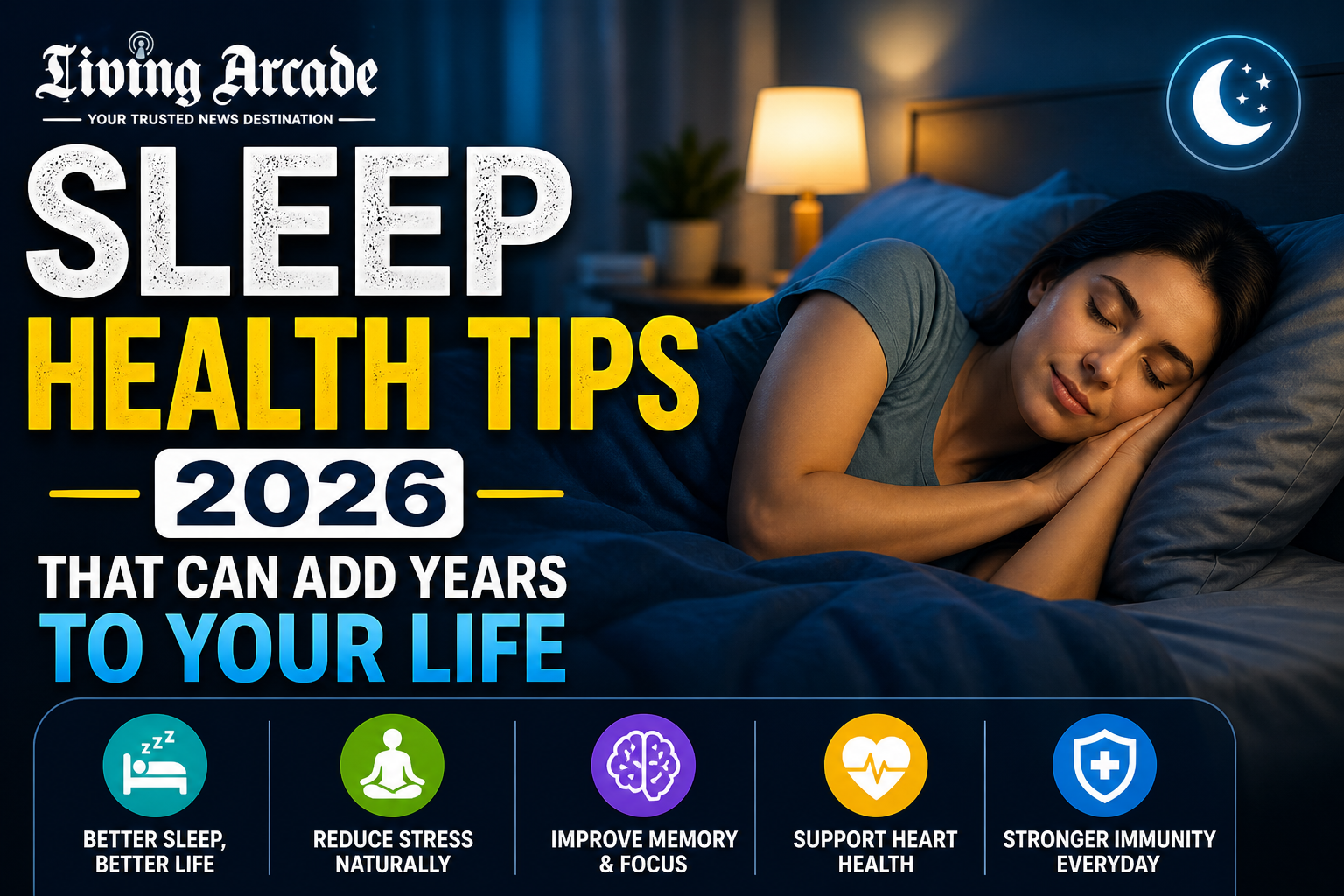
Sleep Health Tips 2026 That Science Says Can Add Years to Your Life
Living Arcade Lifestyle Desk | May 1, 2026
Sleep health tips 2026 are no longer a soft wellness topic. They are a matter of how long you live. New research from Oregon Health and Science University, published in the journal SLEEP Advances, confirms that regularly sleeping less than seven hours is directly linked to a shorter lifespan. The finding is striking for one specific reason. In the analysis, insufficient sleep outweighed both diet and exercise as a predictor of lifespan.
Read that again. Not diet. Not exercise. Sleep.
For millions of Bangladeshi-Americans who work long hours, raise children across time zones, and carry the pressures of building a life in a new country, this finding is not abstract. It is personal. And the science of sleep in 2026 now gives us more practical tools than ever before to fix it.
Why Sleep Health Tips 2026 Are Different from Before
For decades, the medical community treated sleep as something that happened after the real work of health was done. Eat well. Exercise. Then sleep if you have time.
That era is ending. Sleep has become one of the most mainstream health priorities of 2026. People began connecting the dots between poor sleep and everyday habits, such as that evening glass of wine or the 3pm coffee. Once unseen, these disruptors are now tracked, scored, and shared through wearables like the Oura Ring and WHOOP, which turned rest into a measurable metric.
Cognitive decline, lower energy, and loss of strength are changes often associated with aging. But many of these changes happen gradually over time and are strongly linked to chronic poor sleep, not age alone.
Sleep is now understood as an active biological process. Your brain clears toxic waste during deep sleep. Your heart regulates blood pressure during rest. Your immune system rebuilds during the night. Your hormones reset. Your memories consolidate. None of this happens when you are awake.
The 7-Hour Rule: What the Research Actually Says
The most important of all sleep health tips 2026 is also the simplest. Sleep seven to nine hours every night, without exception.
Adults should get between seven and nine hours of sleep nightly to support brain, immune, and cardiovascular health, according to medical experts. Good sleep supports healthy metabolism and immune function. It also improves mood, focus, and stress resilience.
Good sleep also makes it easier to maintain the daily habits that protect long-term health, including better nutrition, regular exercise, and more consistent decision-making.
In other words, sleep does not compete with your other health goals. It makes all of them easier.
The Oregon Health and Science University study analyzed a large national database of survey patterns related to life expectancy across counties throughout the United States. Researchers compared county-level life expectancy data with CDC survey data collected between 2019 and 2025. When researchers evaluated lifestyle factors tied to how long people live, sleep stood out clearly above diet and exercise.
Your Bedroom Environment Is Quietly Destroying Your Sleep
Most people focus on how many hours they sleep. Fewer people focus on where they sleep and what that environment does to their body overnight.
Research published in Environmental Research and Sleep Medicine Reviews demonstrates that bedroom temperature, humidity, and air quality directly affect sleep duration, sleep fragmentation, and time spent in deeper sleep stages.
The human body naturally lowers its core temperature as it prepares for sleep. A room that is too warm actively interferes with that process. Most sleep researchers recommend a bedroom temperature between 16 and 19 degrees Celsius for optimal sleep.
Artificial light in the evening suppresses melatonin release and delays the circadian signals that regulate sleep timing. This includes the blue light from phone screens, laptop screens, and even overhead LED lighting. Looking at a screen in the hour before bed tells your brain it is still midday. Your body responds accordingly and refuses to wind down.
Practical fix: set your phone to night mode after 9pm, lower room temperature before bed, and keep the room as dark as possible. These three changes cost nothing and can measurably improve sleep quality within one week.
How Stress and Purpose Affect Your Sleep Quality
The Bangladeshi-American experience carries specific stressors that affect sleep in ways that differ from the general population. Financial pressure, family obligations in two countries, cultural expectations, immigration uncertainty, and long work hours all activate the same stress response system that disrupts sleep.
Managing stress levels is important for optimal wellness. In the experience of leading longevity doctors, stress balance is a key to health and may also help lower the risk of neurodegenerative diseases like Alzheimer’s.
A strong sense of purpose is one of the most powerful and underestimated predictors of longevity. Studies show that people who have meaningful pursuits have lower levels of chronic inflammation and a reduced risk of early death. Purpose activates both psychological and biological pathways. It influences stress regulation, immune balance, and even cellular repair mechanisms.
This finding matters deeply for diaspora communities. People who feel connected to their work, their family, their community, and their identity sleep better. People who feel isolated, purposeless, or overwhelmed sleep worse. Building a life with meaning is not a luxury. It is a health intervention.
Sleep Wearables in 2026: What Works and What Does Not
Recent research from Stanford University in 2026 demonstrates that AI models trained on sleep study data can predict the risk of numerous diseases, including cardiovascular disease and neurological disorders, by analyzing physiological signals recorded during sleep. This suggests that sleep monitoring could become an important component of preventive healthcare.
Wearables like the Oura Ring and WHOOP now track heart rate variability, respiratory rate, body temperature, and sleep stages throughout the night. They generate a daily readiness score that tells you how recovered your body is. Many users report that seeing their data changes their behavior. When you can see that alcohol at 10pm cut your deep sleep by 40 minutes, you stop doing it.
AI sleep apps can identify patterns in your data that you might not notice yourself, such as alcohol-related disruption, late-night exercise, and inconsistent wake times. This pattern-recognition value is real.
However, the same researchers offer a caution worth taking seriously. An emerging concern called orthosomnia describes a condition in which individuals become overly focused on optimizing sleep metrics, potentially increasing anxiety about sleep. Tracking your sleep should reduce stress about sleep, not create it. If checking your sleep score first thing every morning makes you anxious, put the wearable away for a week.
Brain Health and Sleep: The Connection You Cannot Ignore
People are shifting their focus to brain health in 2026. The goal is to proactively preserve and optimize brain volume, white matter integrity, and neuroinflammation. People are prioritizing lifestyle factors such as aerobic and resistance exercise, sleep optimization, stress management, and social engagement, all of which have been shown to support cognitive resilience. Advancements in cognitive wellness could unlock $26 trillion in global economic value by 2040.
Sleep is the single most important driver of brain health on that list. During deep sleep, the brain’s glymphatic system activates and clears metabolic waste products, including amyloid beta, the protein associated with Alzheimer’s disease. This process only occurs during sleep. There is no waking substitute.
For Bangladeshi-Americans who are caring for aging parents either in the US or back home, and who worry about their own cognitive future, this is actionable information. Protecting your sleep tonight protects your brain for the next 30 years.
Six Practical Sleep Health Tips 2026 You Can Start Tonight
The science is clear. Here is what it tells you to do in practical terms.
Keep a fixed wake time every day, including weekends. Your circadian rhythm anchors to your wake time, not your sleep time. Waking at the same hour every morning is the single most powerful sleep habit you can build.
Stop caffeine by 2pm. Caffeine has a half-life of five to six hours. A coffee at 4pm still has half its caffeine in your bloodstream at 10pm and is actively blocking the adenosine receptors that create sleep pressure.
Lower your bedroom temperature before sleep. Set your thermostat between 16 and 19 degrees Celsius or use a lighter blanket. Your body needs to cool down to fall asleep.
Dim all lights after 9pm. This includes your phone, TV, and ceiling lights. Artificial light in the evening suppresses melatonin release and delays the circadian signals that regulate sleep timing.
Protect your first 90 minutes of sleep. The first sleep cycle of the night contains the most slow-wave deep sleep. Going to bed at a consistent time protects that cycle. Staying up late for an extra episode of television is trading your most valuable sleep for your least valuable entertainment.
Build a 10-minute wind-down ritual. Breathwork and practices like yoga and Pilates are now recognized for their measurable effects on the nervous system, making them more mainstream, more repeatable, and in some settings even prescribed by doctors. Even five slow breaths in through the nose and out through the mouth before lying down lowers cortisol and tells your body the day is over.
The Bottom Line on Sleep Health Tips 2026
Sleep is no longer the thing you sacrifice to get more done. It is the thing that makes everything else possible. The science of 2026 is unambiguous on this point. Seven hours is the floor. Nine hours is the goal. What happens between those hours, in a cool, dark, quiet room, with a calm nervous system and a life that feels meaningful, determines how long you live and how well you live it.
Living Arcade covers wellness, lifestyle, and health stories for the Bangladeshi-American community and beyond. Read our Lifestyle section for more evidence-based guides on nutrition, mental health, fitness, and family wellbeing. You can also explore our Bangladesh Health section for coverage of public health developments back home.
![Picture of Mahibur Fakir [Hillol]](https://secure.gravatar.com/avatar/5d35a11815be0a5f73b6180975d1521fdd7694c880473d8ad5c74749dce26bd6?s=176&d=mm&r=g)