![Picture of Mahibur Fakir [Hillol]](https://secure.gravatar.com/avatar/5d35a11815be0a5f73b6180975d1521fdd7694c880473d8ad5c74749dce26bd6?s=96&d=mm&r=g)
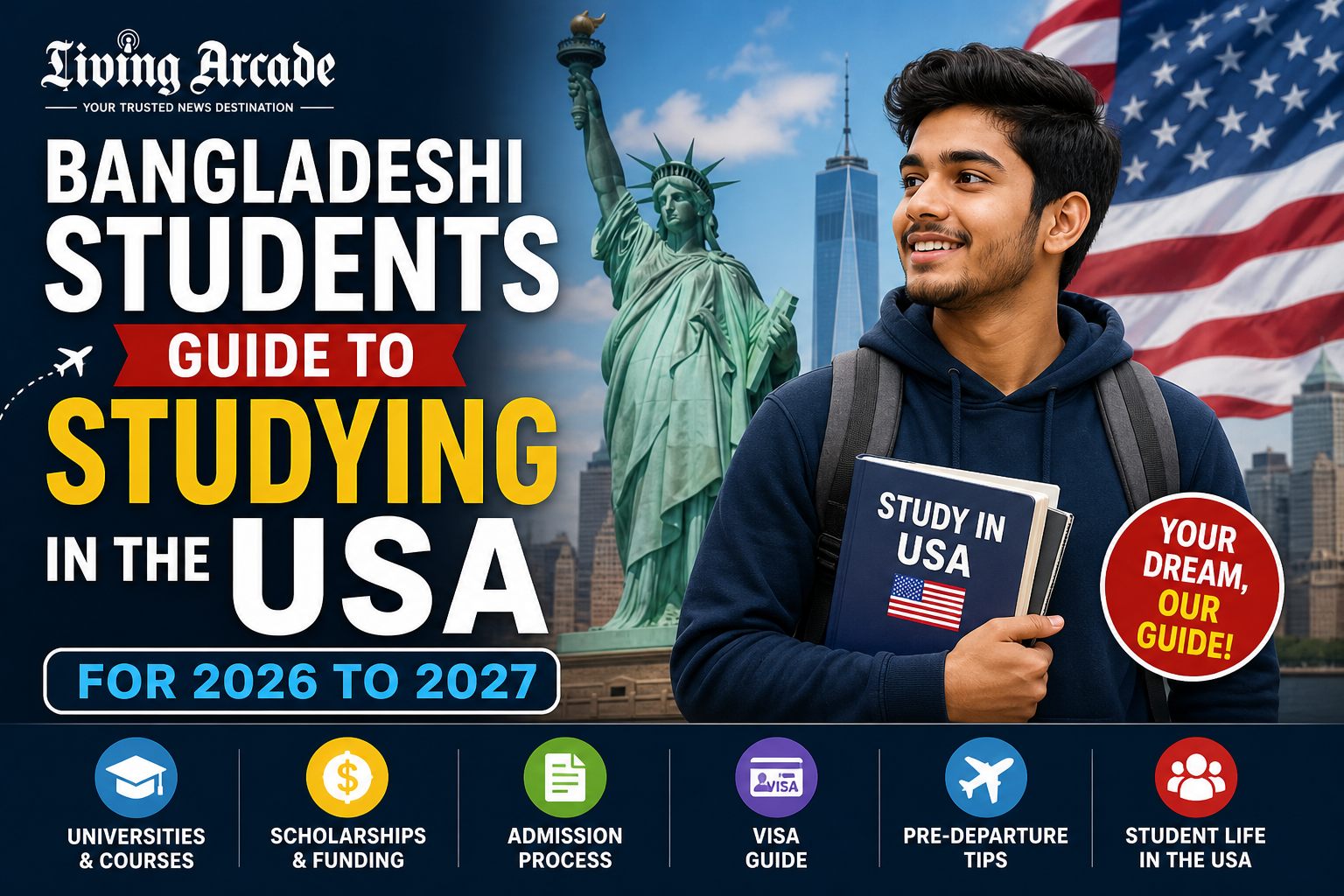
From Dhaka to America: The Complete Guide for Bangladeshi Students Applying to US Universities for 2026 to 2027
By Living Arcade News Desk | May 2, 2026
For generations of Bangladeshi students, a university degree from the United States has represented the highest aspiration in higher education. Today, that aspiration is more achievable than ever. The number of Bangladeshi students studying in the United States has reached an all-time high, with more than 17,000 currently enrolled in U.S. institutions. But the road from Dhaka to an American campus requires careful planning, months of preparation, significant financial investment, and a thorough understanding of a multi-step bureaucratic process that has no room for error.
This guide is designed to give aspiring students and their families a clear, factual, and complete picture of what studying in America for the 2026 to 2027 academic year actually requires.
Understanding the US Student Visa: Which Type Do You Need?
Before applying to any university, every Bangladeshi student must understand the type of visa that governs their study in the United States. As a Bangladeshi international student looking to study in the US, you can choose from three main student visa categories: F-1, J-1, or M-1. The F-1 visa is the most common option for international students who want to pursue full-time academic programs in the US. With an F-1 visa, you can attend a college or university and may also be eligible for Curricular Practical Training (CPT) during your studies or Optional Practical Training (OPT) during or after graduation, both of which offer valuable work experience related to your degree. The J-1 visa is for international students participating in an approved study or work-based exchange program recognized by the U.S. Department of State.
For the overwhelming majority of Bangladeshi students pursuing undergraduate, master’s, or doctoral programs, the F-1 visa is the correct and most appropriate pathway.
Required Documents: What You Must Prepare
The visa and admissions process demands a comprehensive and carefully organized set of documents. Missing a single item can delay or derail an application that has taken months to build. To apply for a USA student visa, Bangladeshi students must prepare the following: a valid passport, Form I-20 provided by the US institution after admission, DS-160 Form which is the Online Nonimmigrant Visa Application, visa fee payment receipt including the SEVIS I-901 fee, academic records including transcripts, certificates, and diplomas, standardized test scores such as SAT, GRE, GMAT, or TOEFL and IELTS, financial proof including bank statements, sponsor letters, and scholarships, and passport-sized photographs meeting US visa specifications.
On the academic testing side, English proficiency requirements typically call for a TOEFL score of 90 or above, an IELTS score of 6.5 or above, or a Duolingo English Test score of 115 or above. Graduate applicants should additionally check whether their chosen program requires GRE or GMAT scores, as requirements vary by institution and discipline.
Evidence of ties to Bangladesh is equally important and helps demonstrate intent to return after completing studies. This includes property ownership documents in your or your family’s names, employment letters for you or your parents, family photographs and relationship documentation, and business registration if your family owns businesses. These documents address one of the most critical concerns US consular officers evaluate during the visa interview.
The Step-by-Step Application Process
Step 1: Research and Shortlist Universities (12 to 18 Months Before Start Date)
As an international applicant, it is strongly recommended to begin preparing 12 to 18 months in advance of your target intake. Research universities by program strength, location, tuition cost, scholarship availability, and acceptance rates for international students. Match your academic profile honestly to the universities on your list and create a tiered list of reach, match, and safety schools.
Step 2: Take Standardized Tests (10 to 14 Months Before)
Register and sit for required English proficiency exams such as IELTS or TOEFL as early as possible, since scores can take weeks to process and you may want to retake them if your first score falls short. Graduate applicants should simultaneously prepare for GRE or GMAT examinations if required.
Step 3: Submit University Applications (August to January for Fall 2026 to 2027)
Early Action and Early Decision deadlines for Fall 2026 to 2027 typically fall between November 1 and November 15. Regular Decision deadlines for most universities fall in January or February. Rolling Admissions continue until seats are filled. Apply to a range of universities to maximize your chances. Submit your Statement of Purpose, Letters of Recommendation, and academic transcripts well ahead of each deadline.
Step 4: Receive Acceptance and Request Your I-20 (January to March)
Once a university issues an acceptance letter, the next and most critical administrative step begins. You must obtain your admissions paperwork from a Student and Exchange Visitor Program certified institution. You will then use the I-20 to obtain an F-1 visa from the US consulate. The I-20 is not just a document. It is the formal record of your enrollment that the entire visa process depends upon.
It is also important to let your school know where and how to send your I-20 to avoid delays or having it get lost in the mail, which can be a common issue with deliveries to Bangladesh.
Step 5: Pay the SEVIS Fee
Once you receive your I-20, you must pay the SEVIS I-901 fee before scheduling your visa interview. You will need your SEVIS ID number from your I-20, a credit or debit card with international payment capability, and your passport information. The payment website accepts major credit cards, including those issued by Bangladeshi banks if they have international transaction authorization. After completing payment, print multiple copies of your receipt. Pay the SEVIS fee at least three to five business days before your scheduled visa interview to ensure the payment appears in the system when consular officers review your application.
Step 6: Complete the DS-160 Online Application
The DS-160 US visa application collects comprehensive information about your background, travel history, education, and plans in the United States. Fill this form with absolute accuracy. Any inconsistency between the DS-160 and your other documents will raise red flags at the interview.
Step 7: Pay the Visa Application Fee and Schedule Your Interview
To apply for the American F-1 Student Visa, you will also need to pay a fee of 160 USD. Depending on your situation, American authorities will allow you to pay this fee online, at a visa application centre in Bangladesh, or through a bank transfer. After payment, schedule your visa interview at the US Embassy in Baridhara, Dhaka, as soon as possible.
Step 8: Attend the Visa Interview
The US Embassy in Dhaka is located in Baridhara. Plan your interview logistics in advance if you are traveling from outside Dhaka. Traffic in Dhaka can be unpredictable, so allow extra time for your appointment. Arrive 15 to 30 minutes before your scheduled time. Late arrivals may need to reschedule entirely.
During your interview, be prepared to answer questions such as: How did you perform academically in previous studies, including standardized test scores and GPA? How are you paying for tuition, room, board, transportation, and all other costs? Will you leave the United States after you graduate to return home? Answer all questions confidently, briefly, and honestly.
Step 9: Prepare for Travel and Arrival
If your visa is approved, you cannot enter the United States more than 30 days in advance of the date shown on your I-20. Your initial entry to the United States must be to attend the same school annotated on your visa. Book your flights accordingly and ensure all documents, including your passport, I-20, and visa fee receipts, are carried in your hand luggage and never checked in.
The Cost of Studying in the United States
Financial preparation is where many Bangladeshi families are caught off guard. The numbers are significant and must be planned for in full before any application begins.
Studying in the US can be expensive, with total costs ranging from 32,000 to 60,000 USD per year, covering tuition, housing, and other living expenses.
In 2025, the average tuition fees in the USA at a public university were 25,415 USD for out-of-state and international students. At private universities, the average tuition fee was 44,961 USD annually. From 2025 to 2026, the average tuition fees at private universities increased by about 3.3 percent.
In addition to tuition, living expenses can add another 15,000 to 30,000 USD a year to your budget. Costs include health insurance, which can be around 2,000 USD a year, food and personal expenses of roughly 3,000 to 5,000 USD, and books and materials of 500 to 1,000 USD annually. Visa-related costs alone can exceed 500 USD when all fees are combined.
All international students are required to show proof of sufficient funding for all educational and living expenses for one academic year as part of their I-20 and visa process per Department of Homeland Security regulations. International students are not eligible for US financial aid, and DHS regulations limit employment opportunities for F-1 status holders, so students should not plan to use income earned in the United States to support tuition or living expenses.
Graduate students pursuing research-based programs can significantly reduce their financial burden. For graduate students, especially in STEM fields, assistantships are the gold standard of funding. These are academic appointments where you work roughly 15 to 20 hours per week in exchange for financial benefits. Stipends in 2026 typically range from 1,500 to 3,000 USD per month depending on the university and local cost of living.
Visa Challenges: What Bangladeshi Students Must Know
The F-1 visa process is not merely a formality. It is a rigorous evaluation by US consular officers, and Bangladeshi applicants face specific challenges that demand careful preparation.
Wait Times Are Long
As of March 2025, the current US visa appointment wait time for students and exchange visitors in Dhaka, Bangladesh, was 258 days. These wait times do not include time for administrative processing and are subject to change. This single data point makes one thing absolutely clear: students planning to study in the Fall of 2026 should be scheduling their visa appointments now, without delay.
Approval Rates Are Not Guaranteed
The estimated approval rate for Bangladesh’s F-1 visa applications in fiscal year 2022 was 65 percent. In fiscal year 2023, the approval rate slightly decreased to 63.75 percent. More than one in three applicants is refused. Understanding why refusals happen is as important as knowing what is required for approval.
The Most Common Reason for Refusal
The most common reason that visa officers reject a student’s F-1 visa is the demonstration of intent to stay in the United States after graduation. Make it as clear as possible that your only plan is to study in the United States and that you will return home after graduation. Fraud or misrepresentation, unlawful presence in the United States, health-related grounds, criminal grounds, or security-related grounds are also common reasons for denial.
New Developments in 2026
Bangladeshi students must be aware of recent policy changes at the US Embassy in Dhaka. Starting January 21, 2026, nationals of Bangladesh who are found otherwise eligible for a B-1 and B-2 visa must post a bond of up to 15,000 USD. Presidential Proclamation 10998 has also suspended or limited entry and visa issuance to nationals of 39 countries. Applicants who are subject to this proclamation may still submit visa applications and attend scheduled interviews, but they may be ineligible for visa issuance or admission to the United States. Students should monitor the US Embassy Dhaka website regularly for the most current instructions, as policies in 2026 are subject to change.
Important Deadlines at a Glance
For Bangladeshi students targeting Fall 2026 to 2027 enrollment, the following timeline serves as a practical roadmap.
August to September 2025 was the time to finalize university lists and begin test preparation. October to November 2025 was the period for submitting Early Decision and Early Action applications. January to February 2026 was the Regular Decision deadline window at most universities. January to March 2026 was the period for receiving admission offers and requesting the I-20 form. April to June 2026 is the window for paying SEVIS fees and booking the F-1 visa interview. For students targeting Spring 2027 enrollment, preparation should ideally begin between April and June 2026, with applications submitted by August or September 2026 to allow adequate time for admissions decisions, I-20 issuance, and F-1 visa processing.
Tips for a Successful Application
Drawing on years of experience from students who have successfully navigated this process, several principles consistently separate those who succeed from those who struggle.
Start earlier than you think necessary. Begin the application four to six months before the program starts at the absolute minimum, and prepare all academic, financial, and language certificates well in advance. Given current visa wait times in Dhaka, starting a full year ahead is not excessive. It is prudent.
Be meticulous with financial documentation. The single most important document beyond the I-20 is your financial proof. Bank statements must show funds that have been sitting for at least three to six months and must cover a full year of tuition and living expenses. Freshly deposited large sums raise suspicion with consular officers and can result in immediate refusal.
Practice your visa interview thoroughly. The consular officer’s questions are brief but consequential. Know the name of your university, your program, your intended graduation date, your field of study, and your career plans in Bangladesh after returning. Hesitation, vagueness, or inconsistency can end the process in minutes.
Pursue scholarships aggressively and early. Numerous funding opportunities exist for Bangladeshi students, including the Fulbright Foreign Student Program, university-specific merit scholarships, and departmental assistantships for graduate students. Most scholarship deadlines align with or precede university application deadlines, so research them simultaneously.
Safeguard every document. Keep digital and physical copies of your passport, I-20, DS-160 confirmation, SEVIS payment receipt, and visa fee receipt. Carry originals in hand luggage when traveling, never in checked baggage.
Conclusion: Plan With Precision, Pursue With Determination
America remains one of the most rewarding destinations in the world for higher education, and Bangladesh’s growing presence in US universities reflects the ambition and capability of this generation of students. But the process demands the same qualities that will serve students well throughout their academic careers: discipline, preparation, and an absolute commitment to accuracy.
For every Bangladeshi student who has ever looked at an American university campus in a film and thought that could be me, the answer in 2026 is: it can be. Start today.
![Picture of Mahibur Fakir [Hillol]](https://secure.gravatar.com/avatar/5d35a11815be0a5f73b6180975d1521fdd7694c880473d8ad5c74749dce26bd6?s=176&d=mm&r=g)