![Picture of Mahibur Fakir [Hillol]](https://secure.gravatar.com/avatar/5d35a11815be0a5f73b6180975d1521fdd7694c880473d8ad5c74749dce26bd6?s=96&d=mm&r=g)
DHAKA, April 24, 2026 — LivingArcade Newsdesk
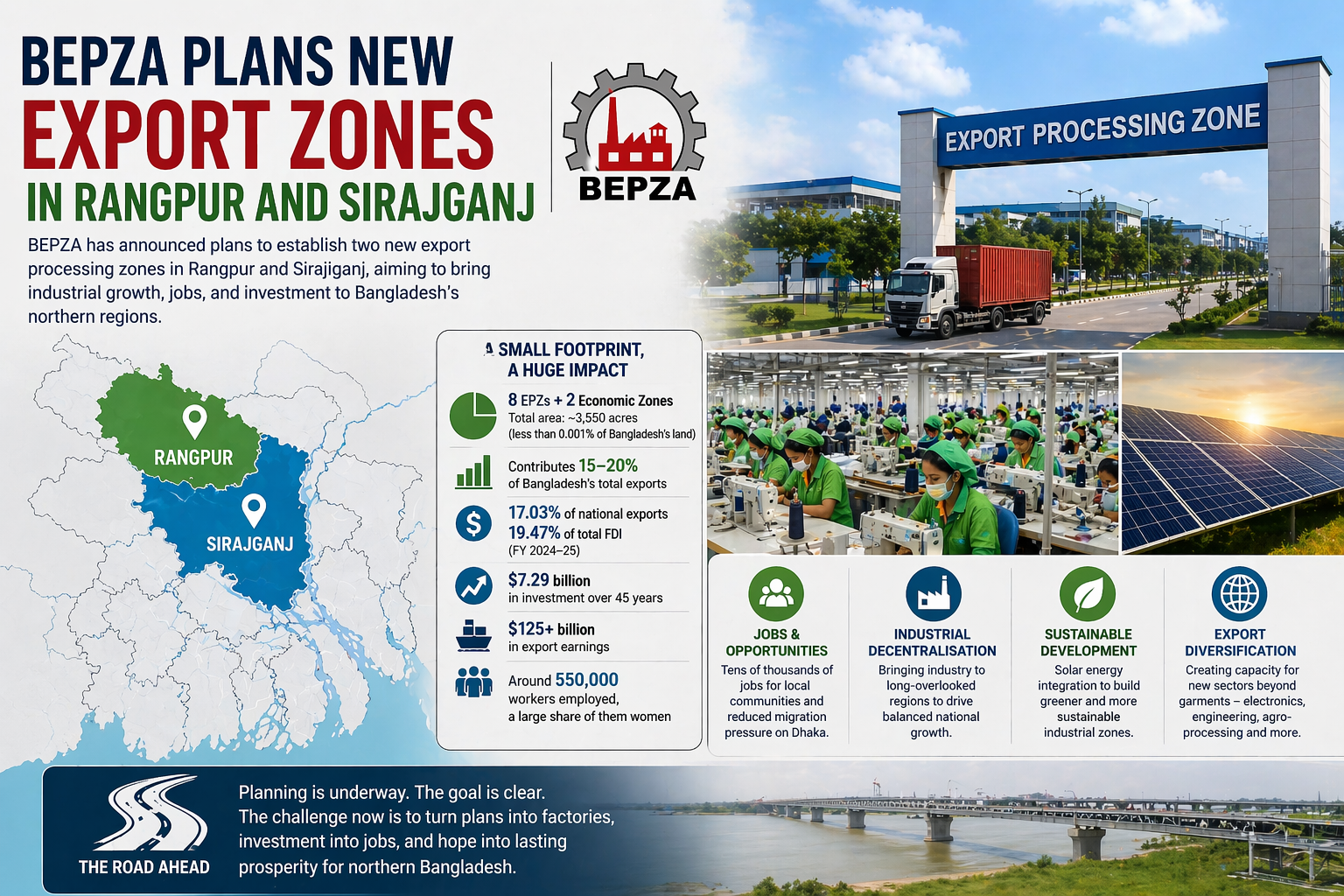
Bangladesh is preparing to push its industrial frontier northward. The Bangladesh Export Processing Zones Authority better known as BEPZA has announced plans to establish two new export processing zones in Rangpur and Sirajganj, in a move that officials say will bring meaningful industrial activity to regions long left behind by the country’s export boom.
The announcement was made as BEPZA marked its 46th anniversary, celebrating four and a half decades since its formal establishment in 1981 under the Prime Minister’s Office. What began as a single initiative to attract foreign capital has grown into one of the country’s most consequential economic institutions and its leadership says the next chapter of that story will be written in the north.
The Scale of What BEPZA Already Does
To understand the significance of the Rangpur and Sirajganj expansion, it helps to understand just how much BEPZA already contributes from a remarkably small footprint.
Eight operational export processing zones, along with two economic zones, occupy a combined area of roughly 3,550 acres less than 0.001 percent of Bangladesh’s total land area. From that sliver of territory, BEPZA contributes between 15 and 20 percent of the country’s total annual exports. In the 2024–25 fiscal year, that figure stood at 17.03 percent of national exports and 19.47 percent of total foreign direct investment. Over 45 years, the authority has attracted $7.29 billion in investment and overseen exports worth more than $125 billion. Each acre of EPZ land now generates approximately Taka 13.82 crore for the economy every year.
Around 550,000 workers are currently employed across BEPZA zones a large proportion of them women, making EPZs one of the most significant drivers of female economic participation in Bangladesh.
Why the North Has Been Left Out
Bangladesh’s industrial map has historically been lopsided. Dhaka, Chattagram, and their surrounding districts absorbed the bulk of investment, garment factories, and economic infrastructure. The north particularly regions like Rangpur Division remained largely agricultural, with high poverty rates, seasonal unemployment, and chronic underinvestment in manufacturing.
This geographical concentration created a structural problem: millions of workers from northern districts travel south each year to find factory employment, straining urban infrastructure in Dhaka while leaving northern economies hollowed out. Decentralising industrial capacity is not just an economic ambition it is a social and demographic necessity.
What the New Zones Will Do
BEPZA’s Executive Chairman Major General Mohammad Moazzem Hossain confirmed that EPZs in Rangpur and Sirajganj are currently in the planning phase, with two other zones in Jashore and Patuakhali already further along in development, with plot allocation expected this year.
Once operational, the Rangpur and Sirajganj zones are expected to attract both domestic and foreign investment, create tens of thousands of jobs in the local labour market, and reduce the pressure on Dhaka as the default destination for rural-to-urban economic migrants. Officials are also emphasising solar energy integration as part of the design philosophy for the new zones a signal that BEPZA is factoring sustainability into its expansion strategy rather than simply replicating the older industrial model.
The Bigger Economic Picture
The EPZ expansion comes as Bangladesh navigates a pivotal economic moment. The country’s GDP growth is projected at around 4.6 percent for the current fiscal year, with forecasts rising toward 5 percent and beyond in FY2027 as inflation gradually eases from its recent highs. Remittance inflows have remained a key pillar of household income and foreign exchange stability.
But economists have repeatedly flagged that Bangladesh’s heavy dependence on ready-made garments which still dominates export earnings leaves the economy vulnerable to shifts in global demand, buyer preferences, and trade policy. Expanding EPZ infrastructure into new regions creates the physical capacity for export diversification: drawing in investors from electronics, light engineering, agro-processing, leather goods, and other sectors that the country has long sought to develop at scale.
BEPZA’s track record gives officials confidence that the model can be replicated. The question now is whether the planning phase for Rangpur and Sirajganj can be converted into ground-breaking and eventually, into factory floors and paycheques with the urgency that northern Bangladesh’s economy demands.
— LivingArcade Newsdesk
![Picture of Mahibur Fakir [Hillol]](https://secure.gravatar.com/avatar/5d35a11815be0a5f73b6180975d1521fdd7694c880473d8ad5c74749dce26bd6?s=176&d=mm&r=g)