![Picture of Mahibur Fakir [Hillol]](https://secure.gravatar.com/avatar/5d35a11815be0a5f73b6180975d1521fdd7694c880473d8ad5c74749dce26bd6?s=96&d=mm&r=g)
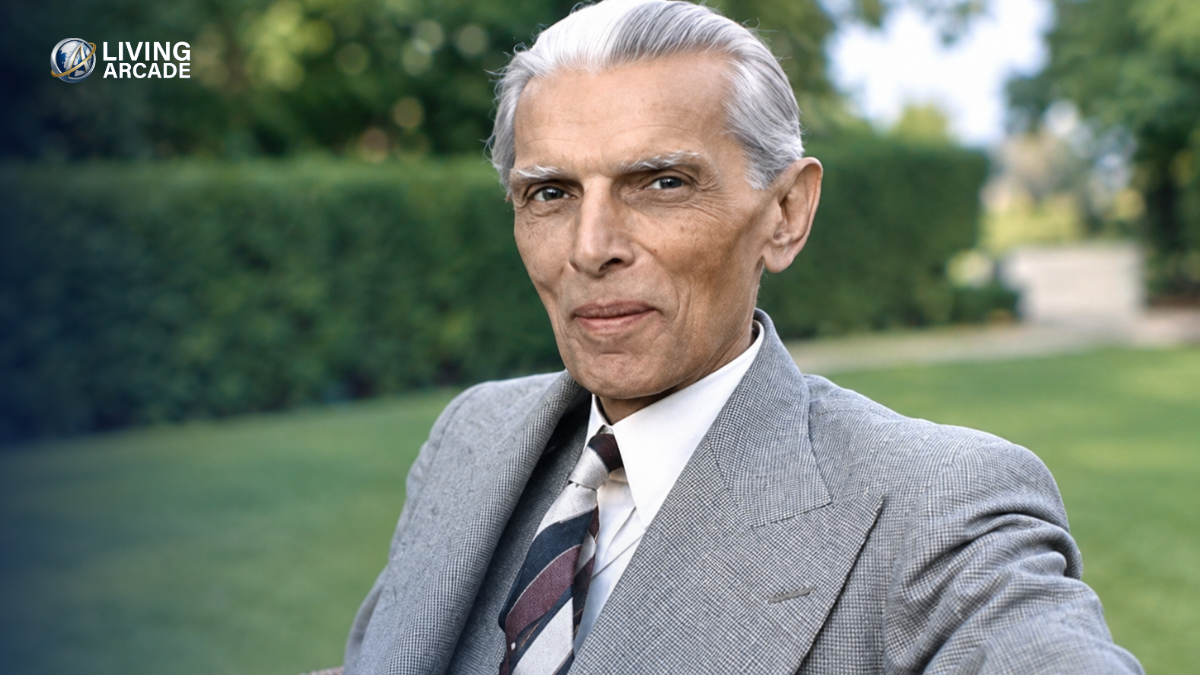
Muhammad Ali Jinnah, the founder of Pakistan, died on 11 September 1948, just over a year after the new country was born. Now, 78 years later, his story still draws strong debate across South Asia. In Pakistan, he is honoured as the “Great Leader.” In India, many see him as the man who divided the land. Here is a clear look at the life, work and legacy of one of the most important political figures of the 20th century.
Early Life of Muhammad Ali Jinnah
He was born Mahomedali Jinnahbhai, most likely on 25 December 1876, in a rented flat at Wazir Mansion in Karachi. At that time, Karachi was part of the Bombay Presidency of British India. However, his school records show a different birth date, 20 October 1875, because authorities did not issue birth certificates at the time.
He was the eldest child of Jinnahbhai Poonja, a merchant, and his wife Mithibai. In 1892, he went to London to join a shipping company as an apprentice. Soon after, he left business to study law and joined Lincoln’s Inn. In 1895, at just 19, he became the youngest British Indian to be called to the bar in England. During these years, he shortened his name to Muhammad Ali Jinnah, and British liberal ideas strongly influenced him.
A Sharp Lawyer in Bombay
At 20, Jinnah started his law practice in Bombay as the only Muslim barrister in the city. His first three years brought very few cases. Later, he turned down a permanent post that offered him a monthly salary of 1,500 rupees. He said he planned to earn that much in a single day, and he eventually did.
His fame grew after the 1908 “Caucus Case” in Bombay. He also defended nationalist leader Bal Gangadhar Tilak and won his acquittal in a sedition case in 1916. In addition, he backed working people. In 1925, he became President of the All India Postal Staff Union, which had 70,000 members, and he helped pass the Trade Union Act of 1926.
From Unity Leader to Muslim League Chief
In his early political life, Jinnah worked inside the Indian National Congress and pushed for Hindu-Muslim unity. He joined the All-India Muslim League in 1913 while staying in the Congress. In 1916, he helped shape the Lucknow Pact between the two parties. For this work, poet and leader Sarojini Naidu called him an ambassador of Hindu-Muslim unity.
Things changed in 1920. The Congress agreed to follow Mahatma Gandhi’s campaign of satyagraha, which Jinnah saw as political anarchy. As a result, he resigned from the Congress. In 1925, he refused a knighthood, saying he preferred to be “plain Mr Jinnah.” Later, he spent most of 1930 to 1934 in Britain, working as a lawyer before the Privy Council. Poet and thinker Muhammad Iqbal and future prime minister Liaquat Ali Khan were among those who pushed him to come back to Indian politics.
How Muhammad Ali Jinnah Led the Pakistan Movement
The 1937 elections were a heavy blow for the Muslim League. After that, Jinnah rebuilt the party and cut the membership fee to just two annas. By December 1939, the League had around three million members, according to Liaquat’s estimate.
On 23 March 1940, the League passed the Lahore Resolution, which called for independent Muslim-majority states. Meanwhile, during the Second World War, British authorities jailed most Congress leaders, allowing the League to grow stronger.In the 1946 provincial elections, the League won 75 percent of the Muslim vote, up from just 4.4 percent in 1937.
Talks with the British and the Congress failed several times. Finally, on 3 June 1947, the partition plan was announced on radio. Jinnah ended his address with “Pakistan Zindabad.” On 11 August, he told Pakistan’s new assembly that citizens were free to go to their temples, mosques or any place of worship. Three days later, on 14 August 1947, Pakistan became independent.
First Governor-General of a New Nation
As Pakistan’s first governor-general, Jinnah faced huge problems. About eight million people migrated to Pakistan amid deadly violence. Although he was over 70 and in poor health, he travelled across West Pakistan to oversee aid for refugees. He also took a salary of just one rupee a month.
In March 1948, he made his only visit to East Bengal after independence. There, in front of a crowd of around 300,000, he said Urdu alone should be the national language. Bengali-speaking people strongly opposed this. In fact, the language issue later became one of the factors behind the 1971 separation that created Bangladesh.
Illness and Final Days
Since the 1930s, Jinnah had suffered from tuberculosis. He kept it secret because he feared it would hurt him politically. He was also a heavy smoker. In 1948, tests confirmed tuberculosis as well as advanced lung cancer.
He spent his last weeks in Quetta and Ziarat, where he weighed just over 36 kilograms. On 11 September 1948, he was flown to Karachi. On the way into the city, his ambulance broke down, and he waited by the roadside for about an hour. He died that night at 10:20 pm, aged 71. Around one million people joined his funeral the next day. Today, he rests at the Mazar-e-Quaid in Karachi.
The Legacy of Muhammad Ali Jinnah
In Pakistan, people know Jinnah as Quaid-e-Azam (Great Leader) and Baba-e-Qaum (Father of the Nation). His birthday, 25 December, is a national holiday. His face appears on all Pakistani rupee notes, and Karachi’s main airport carries his name. Streets in Ankara, Tehran, Chicago and New York are also named after him.
Still, views on him are sharply divided. Historian Ayesha Jalal notes that Pakistan tends to praise him without question, while India often sees him negatively. Some historians argue that Jinnah did not truly want partition and used the Pakistan demand to win political rights for Muslims. Scholars also still debate whether he wanted Pakistan to be a secular state or an Islamic one. Even so, his biographer Stanley Wolpert ranked him as Pakistan’s greatest leader, a man who changed history, changed the world map and created a nation.
For a detailed record of his life, see his Wikipedia biography and the Britannica profile.
Related reads on LivingArcade: [Internal link 1: your South Asia history article] | [Internal link 2: your Bangladesh history or Language Movement article]
Frequently Asked Questions
Who was Muhammad Ali Jinnah?
He was a barrister and politician who led the All-India Muslim League and founded Pakistan in 1947.
When and where was Jinnah born?
He was most likely born on 25 December 1876 at Wazir Mansion in Karachi.
How did Muhammad Ali Jinnah die?
He died of tuberculosis and advanced lung cancer, with pneumonia near the end, on 11 September 1948 in Karachi.
Why is Jinnah called Quaid-e-Azam?
The title means “Great Leader.” It became official through a resolution in Pakistan’s Constituent Assembly on 11 August 1947.
What did Jinnah say about the national language?
In March 1948, he said Urdu alone should be the national language, which Bengali speakers in East Bengal strongly opposed.
Where is Jinnah buried?
He is buried at the Mazar-e-Quaid, a marble mausoleum in Karachi.
![Picture of Mahibur Fakir [Hillol]](https://secure.gravatar.com/avatar/5d35a11815be0a5f73b6180975d1521fdd7694c880473d8ad5c74749dce26bd6?s=176&d=mm&r=g)