![Picture of Mahibur Fakir [Hillol]](https://secure.gravatar.com/avatar/5d35a11815be0a5f73b6180975d1521fdd7694c880473d8ad5c74749dce26bd6?s=96&d=mm&r=g)
DHAKA, April 26, 2026 — LivingArcade Newsdesk
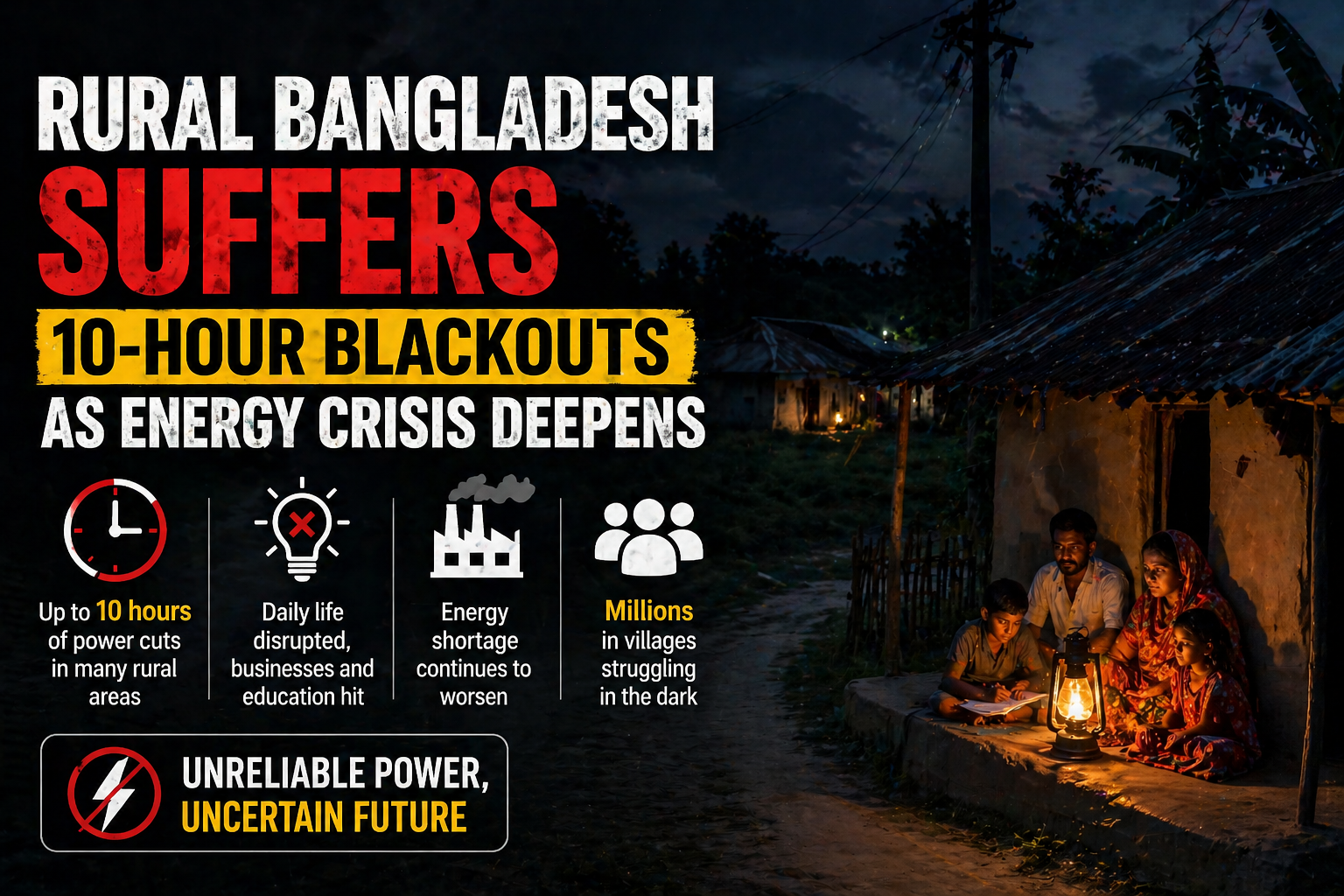
Across rural Bangladesh, the lights are going out and staying out. As April’s punishing heat drives electricity demand to record levels, a deepening energy crisis has left millions of people in villages, towns and industrial zones enduring up to ten hours of daily power cuts, with no clear timeline for when normal supply will return.
The scale of the crisis is staggering. Peak-hour shortages have exceeded 1,500 megawatts daily, with some areas experiencing on average two to three hours of outages though distribution companies acknowledge that rural areas are suffering far longer power cuts. Consumers under the Bangladesh Rural Electrification Board are reporting five to six hours of cuts daily, while daytime peak demand recently reached 15,500MW against a generation of only 14,069MW, leaving a shortfall of over 1,400MW. The shortage exceeded 1,000MW almost every hour, peaking at 1,840MW at 9pm.
GAZIPUR: AN INDUSTRIAL DISTRICT ON ITS KNEES
The crisis is perhaps most acute in Gazipur, one of Bangladesh’s most important industrial districts and home to hundreds of garment factories that power the country’s export economy. Residents say areas that previously experienced around seven hours of daily outages are now facing 8–10 hours of load shedding. The prolonged power cuts have triggered acute water shortages, interrupting routine household tasks such as bathing and cooking.
The strain is equally apparent across Gazipur’s industrial zones, where factory output has declined as frequent outages halt machinery. While some units have turned to diesel-powered generators, high fuel costs and limited availability have made regular operation difficult. Demand in one key area of Gazipur stands at 554 megawatts against a supply of only 313 megawatts.
Adding to the industrial district’s misery, recent nor’wester storms damaged seven transformers in Sreepur and Mawna areas, with fallen trees cutting power lines and causing outages lasting nearly 24 hours in some localities. Long queues for water have formed at community points as household pumps fail without electricity.
RURAL VOICES: “WE HAVE ELECTRICITY FOR ONLY A FEW HOURS A DAY”
Beyond the industrial zones, ordinary Bangladeshis in villages and small towns are bearing the heaviest burden. In Rangpur, rural consumers say the crisis has become unbearable. One resident of Milonpur village said the heat has become intolerable without electricity, noting that supply often lasts only a few hours a day. His son, an SSC examinee, said that studying at night has become nearly impossible due to outages and stifling heat.
Another resident of Mahipur village said his sleep has been disrupted for a week, as electricity is available for only five to six hours in total over any given 24-hour period. A local schoolteacher described the repeated night-time blackouts as unbearable.
In rural areas, frequent outages have cut production in small and medium industries by as much as half, while rising costs are forcing many businesses to rely on expensive alternative energy sources. Agriculture is also under serious strain power-driven irrigation systems are being disrupted, threatening Boro rice cultivation and drying up fields in several regions. Fish hatcheries are reporting lower output due to unreliable electricity supply.
THE DHAKA DIVIDE: URBAN PRIVILEGE IN A NATIONAL CRISIS
One of the most uncomfortable truths of the crisis is that it is not being shared equally. Demand for power has exceeded 16,000 megawatts, yet generation remains between 13,000 and 14,000 megawatts. To bridge the gap, regular load shedding is being carried out almost entirely imposed on rural populations. Dhaka city, by contrast, is being deliberately kept largely free of outages.
Stakeholders in the power sector say that for several years, routine load shedding has occurred during the summer season. To manage deficits, supply is first reduced in rural areas. Only when the shortfall widens further is limited load shedding introduced in urban areas and even then, it remains far lower than in the countryside.
Energy adviser to the Consumers’ Association of Bangladesh, Prof M Shamsul Alam, has been blunt about this inequity. “Load shedding is distributed in a way that protects high-demand urban and commercial areas, while rural feeders are switched off for longer. Even a moderate national shortfall can translate into prolonged outages in villages due to how distribution is managed,” he said.
WHAT IS CAUSING THE CRISIS?
The crisis has multiple, interlocking causes none of them easy to fix quickly.
Gas shortages: Gas-based generation capacity stands at 12,200 megawatts, but output from these plants is currently limited to just over 5,200 megawatts. Gas supply to the power sector has fallen to around 90 crore cubic feet per day down from 100 crore last year reducing generation by about 600 megawatts.
Coal supply disruptions: Indonesia has curtailed coal exports due to the Middle East conflict, disrupting supply to Bangladesh. As a result, a 1,320-megawatt plant in Patuakhali is currently shut down due to coal shortages, while the Banshkhali plant in Chattogram, of the same capacity, is operating at less than half capacity.
Unpaid fuel bills: The situation is further complicated by mounting dues to furnace oil-based power plants, amounting to around Tk 14,000 crore. Operators have warned they may not sustain production unless payments are cleared, raising the risk of further supply cuts.
Plants offline: Of 136 power plants in total, 13 are offline due to gas shortages, nine due to lack of fuel oil, and eight for maintenance. Among the remaining plants, 17 are solar and cannot generate electricity at night. Five diesel-fired plants are also kept shut due to high costs.
GOVERNMENT RESPONSE
The government has acknowledged the severity of the crisis and is attempting a series of emergency measures. Prime Minister Tarique Rahman has called for public cooperation as a series of high-level meetings continues to assess the evolving situation. The Power Minister hinted at imminent power cuts during a meeting with shop owners’ associations and discussed a directive to close shops by 6pm to reduce evening peak demand.
The State Minister for Power confirmed that 110 megawatts of load shedding would be introduced even in Dhaka to redirect electricity toward agricultural irrigation during the critical Aus rice-growing season. He expressed hope that the crisis would ease within a week once two major power plants return to full production.
Officials say coal shipments are beginning to arrive, offering modest relief but caution that load shedding will persist in the near term. For the tens of millions of rural Bangladeshis already sweating through ten-hour blackouts, that near term cannot end soon enough.
— LivingArcade Newsdesk
![Picture of Mahibur Fakir [Hillol]](https://secure.gravatar.com/avatar/5d35a11815be0a5f73b6180975d1521fdd7694c880473d8ad5c74749dce26bd6?s=176&d=mm&r=g)