![Picture of Mahibur Fakir [Hillol]](https://secure.gravatar.com/avatar/5d35a11815be0a5f73b6180975d1521fdd7694c880473d8ad5c74749dce26bd6?s=96&d=mm&r=g)
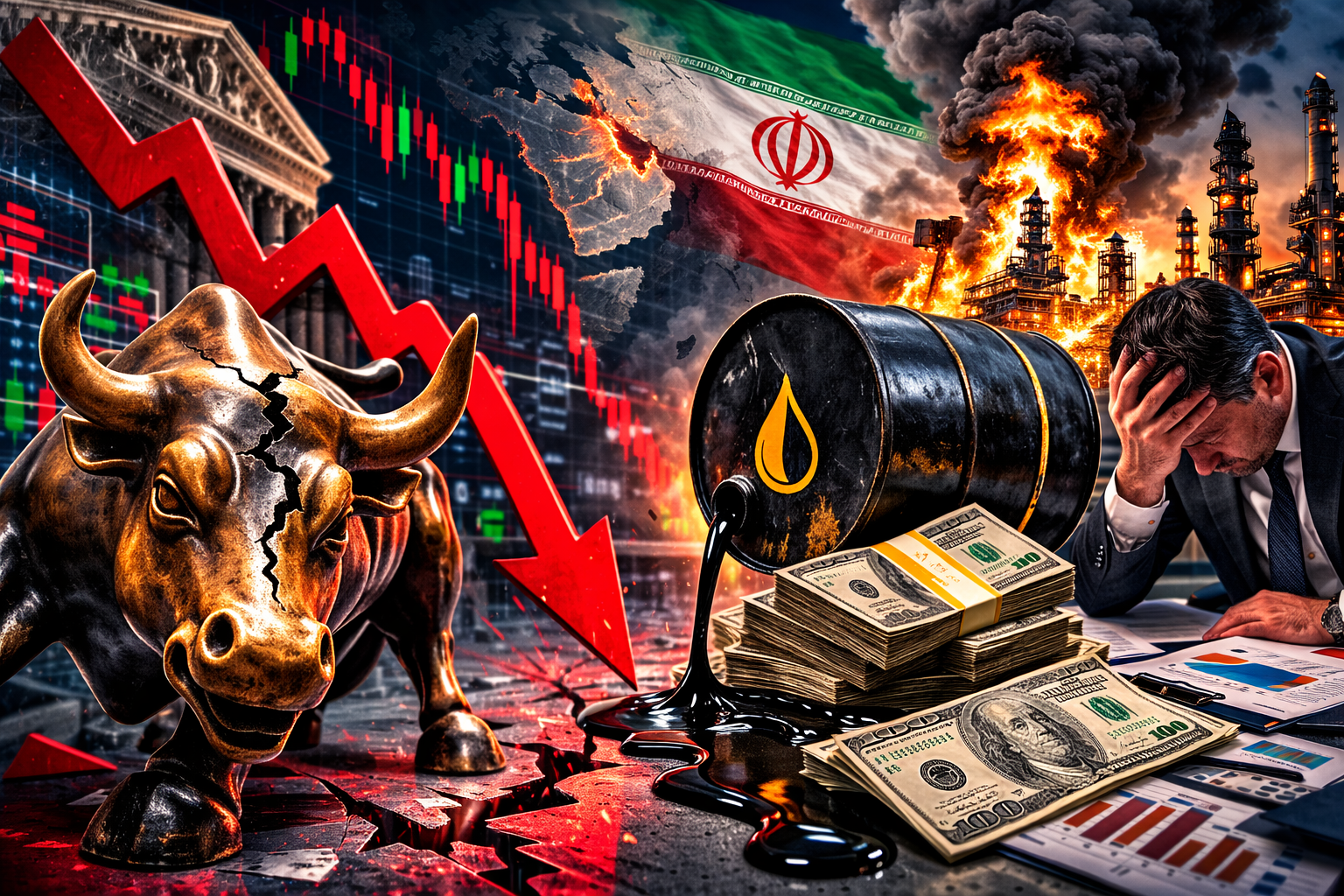
NEW YORK – Wall Street closed out another brutal week under the weight of war, energy, and uncertainty, completing a third consecutive week of losses as investors confronted the uncomfortable possibility that the conflict between the United States and Iran may not resolve as quickly as markets had initially hoped.
The week’s defining moment arrived Thursday, when Brent crude futures crossed 100 dollars a barrel for the first time since August 2022, a milestone that sent tremors through equity markets worldwide and forced traders to rethink assumptions about inflation, interest rates, and economic growth that had been built up carefully over the previous 12 months.
The Dow Jones Industrial Average fell 739.42 points, or 1.56 percent, closing at 46,677.85. The S&P 500 lost 1.52 percent and settled at 6,672.62, while the Nasdaq Composite shed 1.78 percent to end at 22,311.98. All three indexes posted closing lows for 2026, and the Dow ended below the 47,000 threshold for the first time this year. U.S. Senate
By Friday, U.S. equities finished a rough week lower, with the S&P 500 down 0.6 percent, the Dow losing 0.3 percent, and the Nasdaq 100 shedding 0.7 percent as they struggled to maintain their footing amid intensifying regional conflict and persistent energy market volatility. NPR
Oil: The Market’s Controlling Variable
The extraordinary power of oil over financial markets in 2026 reflects a reality that investors have not confronted this directly since the early 2000s: when a physical commodity that underpins the entire global economy becomes uncertain in supply, everything else becomes secondary.
The catalyst for Thursday’s surge was blunt and deliberate. Crude prices continued to climb after Iran’s newly appointed Supreme Leader Mojtaba Khamenei, who took power on March 9, said that the Strait of Hormuz should remain closed as a tool to pressure the enemy. West Texas Intermediate futures rose 9.72 percent to settle at 95.73 dollars per barrel. U.S. Senate
Brent futures settled higher by 2.67 percent at 103.14 dollars a barrel on Friday. Brent had closed above 100 dollars for the first time since August 2022 on Thursday. Traffic in the Strait has virtually been halted since the U.S. and Israel launched strikes on Iran at the end of February, leaving investors anxiously awaiting progress on that front. NPR
The U.S. government moved to cushion the blow to domestic fuel supplies. The Trump administration announced it plans to release 172 million barrels from the U.S. Strategic Petroleum Reserve, while the International Energy Agency also agreed to release 400 million barrels from coordinated global reserves. Houston Public Media The moves softened the peak but did not reverse the underlying upward pressure, as the market’s anxiety is structural, not temporary.
Stagflation: The Word That Will Not Go Away
The word that market strategists and economists have returned to repeatedly in recent weeks is one that carries memories of a deeply painful era in American economic history: stagflation.
Defense Secretary Pete Hegseth signaled a further escalation Friday by announcing the largest wave of U.S. strikes against Iranian targets yet, cementing the blockade of the Strait of Hormuz and stoking fears of a prolonged stagflationary global environment. This pressure drove investors toward the dollar, pushing major benchmarks toward a third straight week of losses while high energy costs forced markets to reprice 2026 rate expectations. NPR
The Federal Reserve, which had entered the year with room to maneuver on rate policy, now finds itself in a far more constrained position. Chances of a Federal Reserve rate cut this month are practically zero, and odds of a cut in 2026 do not rise above 50 percent until September, according to the CME FedWatch Tool. Chances of two cuts or more this year fell to around 35 percent from almost 85 percent a month ago, meaning the market generally anticipates just one cut this year as war-related inflation has dented hopes for lower rates. Houston Public Media
Fresh PCE inflation data released showed core readings rising 0.4 percent month over month, slightly above expectations, while headline PCE increased 0.3 percent. GDP revisions indicated weaker expansion in prior quarters, adding to the case for accommodative policy amid geopolitical strains. GovTrack.us Slow growth and rising inflation arriving simultaneously is precisely the combination that markets dread most, because it strips away the tools that policymakers would normally use to address either problem individually.
Sector by Sector: Who Is Winning and Who Is Losing
The war economy is not uniformly bad for everyone on Wall Street. The divergence between winners and losers has been dramatic and instructive.
The iShares Global Energy ETF rose to its highest level since May 2008, with names such as Occidental Petroleum, EOG Resources, Marathon Petroleum, and Shell, among others, scoring new 52-week highs. U.S. Senate Defense contractors have followed a similar trajectory, as the scale of Operation Epic Fury has driven spending expectations to levels not seen in a generation.
On the losing side, the damage has been concentrated in technology, consumer discretionary, and sectors most sensitive to credit costs. Software giants led the decline, with Adobe plunging 7.6 percent after a guidance miss and the announcement of a CEO departure, while Meta, Palantir, and Oracle dropped between 3.8 and 1.7 percent. NPR
Ulta Beauty lost 12 percent after reporting weak earnings. Restaurant analysts warned that a meaningful increase in gas prices for an extended period would pressure discretionary consumer spending and reduce restaurant traffic. Best-positioned stocks in the sector highlighted by analysts included McDonald’s, for its value positioning, Starbucks, which touts turnaround momentum, and Texas Roadhouse, which has shown consistent execution. NPR
The Week Ahead: Nvidia, the Fed, and a War With No End in Sight
Markets are heading into the coming week with no resolution in sight on the conflict, but with at least one potential bright spot on the calendar. Nvidia’s GTC conference is set to take place from March 16 to 19, and a number of Wall Street analysts have been reiterating their bullish stances on the chipmaker ahead of the event, which could offer support to the broader technology sector if the company delivers on expectations. Congress.gov
The Federal Open Market Committee also meets this week, though no rate action is expected. More important than any policy decision will be the language that Federal Reserve Chairman Jerome Powell uses to describe the committee’s view of a world in which inflation is rising from war-driven energy costs even as economic growth appears to be decelerating.
Some analysts remain cautiously optimistic about the longer-term picture. One strategist at Wells Fargo noted that the firm continues to look through near-term headlines, viewing the conflict and Strait closure as likely lasting weeks to months and not changing the forward outlook meaningfully, and anticipating that WTI will eventually return to the 65 to 75 dollar range. Congress.gov
For now, however, the market moves not on forecasts but on what happens in the Persian Gulf each morning. And each morning in March 2026 has brought something new to worry about.
![Picture of Mahibur Fakir [Hillol]](https://secure.gravatar.com/avatar/5d35a11815be0a5f73b6180975d1521fdd7694c880473d8ad5c74749dce26bd6?s=176&d=mm&r=g)