![Picture of Mahibur Fakir [Hillol]](https://secure.gravatar.com/avatar/5d35a11815be0a5f73b6180975d1521fdd7694c880473d8ad5c74749dce26bd6?s=96&d=mm&r=g)
By Living Arcade Staff | Community | April 2025
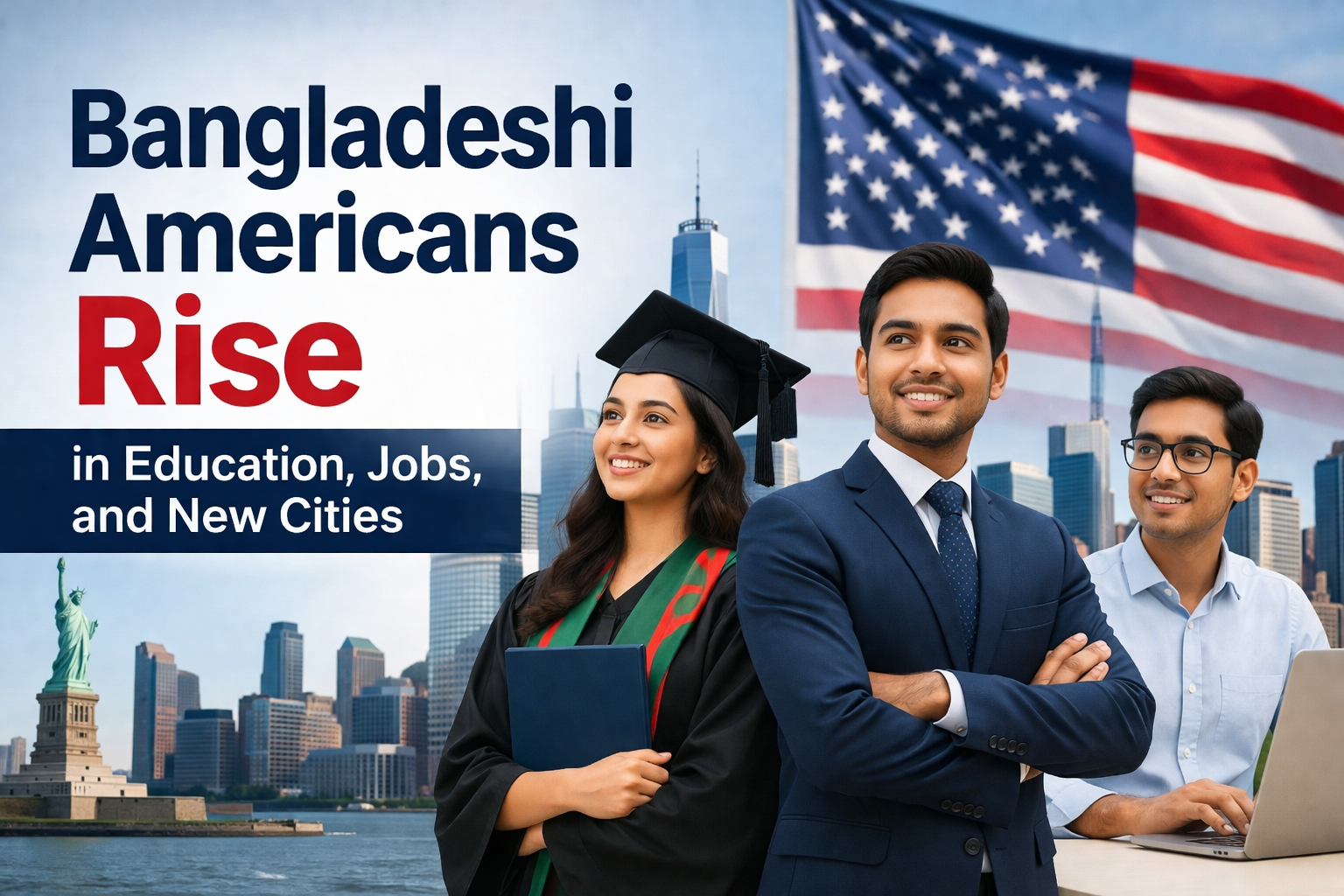
NEW YORK They came with degrees and ambitions. Now, a generation later, Bangladeshi Americans are no longer on the margins of American life they are becoming a part of its fabric.
The Bangladeshi American community has grown to an estimated 270,000 to 300,000 residents across the United States, according to data from the Pew Research Center and U.S. Census-based surveys a figure that tells only part of a much larger transformation underway. While some community leaders cite higher estimates, verified government data points consistently to this range.
A classroom revolution
Perhaps nowhere is the shift more dramatic than in American universities. More than 17,000 Bangladeshi students are currently enrolled at U.S. institutions a staggering increase of over 250 percent in just a decade. Bangladesh now ranks among the top ten source countries for international students in the United States, a milestone that would have seemed improbable a generation ago.
The appetite for American higher education reflects both rising aspirations at home and a recognition that U.S. credentials open doors globally. From engineering programs in the Midwest to business schools on the coasts, Bangladeshi students have carved out a visible, growing presence.
Beyond the bodega and the taxi: a professional evolution
For decades, Bangladeshi Americans were known for anchoring specific economic niches running newsstands in Manhattan, driving yellow cabs, or operating small retail shops in neighborhoods like Jackson Heights, Queens. Those contributions remain significant. But the economic profile of the community is shifting decisively.
A growing number of Bangladeshi Americans are now entering technology, healthcare, academia, and finance. From software engineers in Silicon Valley to physicians in Midwestern hospitals to university professors and Wall Street analysts, the second generation in particular is claiming space in America’s professional class. It is a quiet but consequential upward mobility story.
New zip codes, new roots
The community’s geographic map is being redrawn. Historically, Bangladeshi Americans clustered in a handful of dense urban centers the Bronx and Brooklyn in New York, Hamtramck in Michigan, and pockets of New Jersey. Those remain home to large, established communities. But economic opportunity and the search for more affordable living have pushed the population into unexpected territory.
The Dallas–Fort Worth metroplex in Texas is emerging as a notable growth hub, drawing Bangladeshi professionals lured by the tech sector and a lower cost of living. Northern Virginia and the Maryland suburbs of Washington, D.C., are similarly attracting young families and working professionals, many drawn by government contracting, healthcare, and corporate opportunities in the region.
Culture held close
Economic assimilation has not meant cultural erasure. Across the country, Bangladeshi American communities continue to celebrate Eid, Pohela Boishakh, and Independence Day with festivals and gatherings that draw thousands. University Bangladeshi student associations have proliferated on campuses from California to New England, keeping language, heritage, and community ties alive for a generation born far from Dhaka or Chittagong.
In this way, Bangladeshi Americans are writing a distinctly American story: arriving with very little, building steadily, and now across classrooms, hospitals, and corporate towers becoming impossible to overlook.
![Picture of Mahibur Fakir [Hillol]](https://secure.gravatar.com/avatar/5d35a11815be0a5f73b6180975d1521fdd7694c880473d8ad5c74749dce26bd6?s=176&d=mm&r=g)